Thermal Stress and Power Quality Degradation
Cost Avoidance in Data Center Electrical Infrastructure
Electrical infrastructure aging in data centers is governed by thermal stress and power-quality-induced internal heating. Higher load density, rapid load stepping, and non-linear loading associated with AI compute can, in certain electrical architectures, intensify harmonic distortion and ripple currents. These effects accelerate internal temperature rise and consume thermal life margin faster than traditional IT loads.
Using IEEE and NEMA standards and manufacturer technical data, this analysis illustrates how erosion of thermal margin compresses replacement cycles and increases capital exposure. It also shows how modest restoration of thermal margin can shift replacement events outside a ten-year planning horizon, converting degradation exposure into potential cost avoidance.
Quantitative examples reflect stressed or retrofit operating scenarios and are not intended to describe all AI data center architectures.
Cost Avoidance in Data Center E…
How AI Compute Accelerates Electrical Aging in Data Centers
Electrical infrastructure aging is not new. What is new is the way AI-intensive compute loads interact with existing electrical architectures, accelerating well-understood degradation mechanisms and compressing replacement timelines in certain facilities.
This article outlines the physical drivers behind accelerated aging, explains why power quality acts as a thermal stress amplifier, and shows how modest improvements in thermal margin can translate into meaningful cost avoidance over a standard planning horizon.
Electrical Infrastructure Aging Is Universal
All electrical systems age over time. In AI-intensive environments, that aging can accelerate due to two repeatable operational characteristics:
- Rapid load stepping
Increases thermal cycling stress in power electronics and conductors - Higher non-linear loading
Increases harmonic distortion and ripple current
The magnitude of these effects depends on architectural variables such as:
- UPS rectifier topology
- Harmonic mitigation strategy
- Battery chemistry
- Overall system stiffness
Standards including IEEE 519 and NEMA MG 1 recognize that these factors directly influence internal losses and thermal behavior.
Thermal Aging Physics and Life Reduction
Thermal degradation of insulation systems and electrochemical components follows Arrhenius-type acceleration behavior. A widely used engineering approximation is the 10 °C rule, under which a 10 °C increase in internal operating temperature above rated conditions reduces remaining useful life by approximately 50 percent for many insulation and electrochemical systems.
This relationship is used for comparative aging analysis rather than precise life prediction and applies directly to common data center assets:
- Valve-regulated lead-acid (VRLA) batteries
Elevated temperature accelerates grid corrosion and electrolyte dry-out, reducing service life - Electrolytic capacitors
Increased internal temperature accelerates electrolyte evaporation, raises equivalent series resistance (ESR), and shortens life - Motors and transformers
Higher winding and hot-spot temperatures accelerate insulation aging independent of mechanical condition
[INSERT FIGURE 1: Thermal life acceleration / 10 °C life-halving illustration]
Power Quality as a Thermal Stress Amplifier
Power quality degradation increases internal heating even when ambient room temperature is controlled.
- Harmonic distortion raises RMS current, increasing conductor, winding, and magnetic losses
- Ripple current produces continuous internal heating:
- In capacitors through ESR losses
- In batteries through I²R losses
Compliance at the point of common coupling does not reflect internal equipment exposure. Internal stress is governed by downstream impedance, rectifier behavior, and load aggregation.
- Motors and harmonics
NEMA MG 1 Part 30 recognizes that voltage distortion increases motor losses and winding temperature rise, accelerating insulation aging and often requiring derating even when mechanical loading remains unchanged - Capacitors and ripple current
DC link capacitors are frequently the life-limiting component in VFDs and UPS systems. As capacitors age, ESR increases, further raising internal heating. In high-ripple environments, this mechanism has been observed to shorten capacitor life into the five-to-six-year range in certain operating scenarios - Batteries and ripple exposure
Battery and UPS guidance specifies allowable ripple exposure for standby service. Exceeding these limits materially reduces battery life and can introduce warranty compliance risk
Electrical Stress Profiles in AI-Intensive Operation
The mechanisms described above exist in all modern data centers. In certain AI-intensive facilities, particularly retrofit and mixed-load environments, increased load magnitude and switching frequency produce measurable electrical stress that can explain accelerated aging.
Table A. Illustrative electrical stress profiles observed inselected AI-intensive retrofit scenarios (1 MW block)
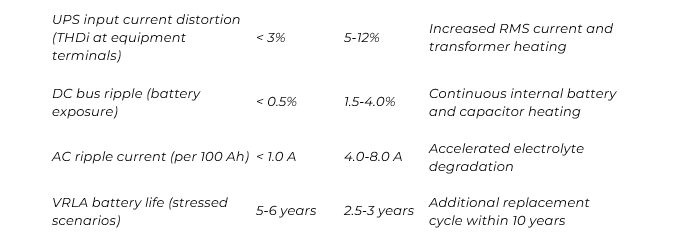
Values reflect measurements at equipment terminals inselected retrofit and mixed-load facilities with limited harmonic mitigationand are not representative of all AI data center architectures.
Replacement Cycle Compression Under Elevated Stress
Thermal and power-quality stress can compress replacement cycles in stressed operating scenarios, creating discrete financial exposure rather than incremental efficiency loss.
Table B. Illustrative replacement cycle compression from thermal and power-quality stress (scenario-based, per 1 MW)
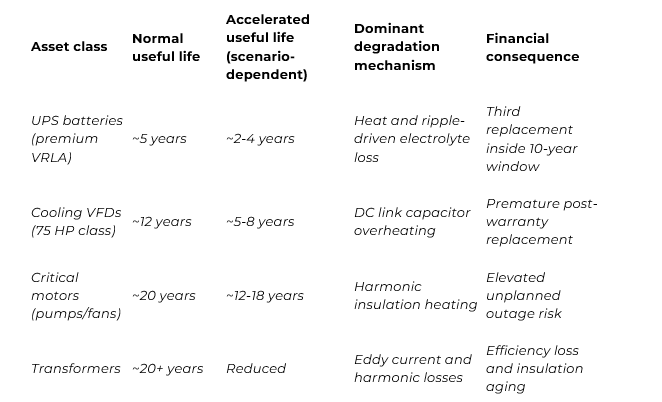
Note: Replacement intervals shown above are illustrative outcomes under elevated thermal and power-quality stress and should not be interpreted as normative asset lifetimes. Actual replacement timing varies materially with redundancy philosophy, procurement scale, battery chemistry, cooling architecture, and maintenance practices.
Skip-Cycle Economics and Cost Avoidance
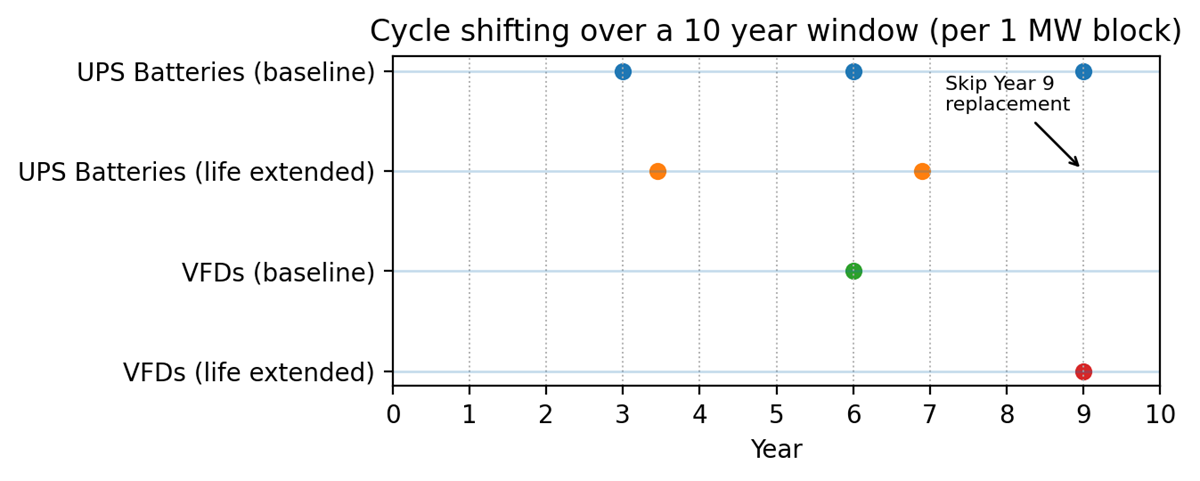
Table C illustrates how modest restoration of thermal margin can, in certain scenarios, shift replacement events outside a 10-year planning window, converting degradation exposure into potential cost avoidance.
Table C. Illustrative cost avoidance via life extension andcycle shifting (scenario-based, per 1 MW)

These figures are illustrative and vary materially by system architecture, redundancy level, maintenance practices, and local cost structures. Outage cost figures represent industry-reported upper-quartile impacts and should be interpreted probabilistically rather than as expected values. Actual financial risk depends on both impact magnitude and event probability, which varies significantly by facility design, redundancy, and operational discipline.
Figure 2. Replacement cycle shift illustrating how modestlife extension removes discrete replacement events from a 10-year planningwindow.
Scope and Applicability
This analysis is most applicable to retrofit and mixed-load facilities operating with legacy UPS architectures or limited harmonic mitigation. Purpose-built hyperscale facilities employing active rectification and lithium-ion storage may experience lower degradation rates, though internal thermal margin remains a governing reliability variable.
Conclusion
AI compute can accelerate established thermal and electrical degradation mechanisms by increasing harmonic distortion, ripple current, and thermal cycling in certain architectures. These effects can compress replacement timelines and increase reliability exposure.
Where modest improvements in power quality and thermal margin shift discrete replacement events outside standard planning horizons, operators may realize meaningful cost avoidance through deferred battery replacements, extended drive life, and reduced outage risk.
References
- IEEE 1013 – Standard for Battery Arrhenius Life Modeling
- IEEE 1188 – Maintenance and Replacement of VRLA Batteries
- IEEE 519 – Harmonic Control in Electric Power Systems
- NEMA MG 1 Part 30 – Motors on Non-Sinusoidal Supplies
- C&D Technologies – Effects of AC Ripple on VRLA Battery Life
- Nichicon – Aluminum Electrolytic Capacitor Technical Documentation
- Ponemon Institute – Data Center Outage Cost Studies