What are harmonics?
What Are Harmonics?
Think of electricity like traffic on a highway. When everything flows smoothly, it is efficient and calm. Harmonics are like cars constantly hitting the brakes or swerving. They create traffic jams, waste energy, and wear everything down faster.
When power flows through a data center, factory, or office, it should resemble a perfect sine wave:
- Clean
- Smooth
- Consistent
Modern electrical loads make that increasingly difficult.
How Harmonics Are Created
Much of today’s infrastructure relies on equipment that draws nonlinear current, including:
- IT equipment
- Variable-speed drives
- UPS systems
- LED lighting
Instead of drawing current smoothly, these loads pull power in pulses. That behavior bends the ideal sine wave into a distorted shape.
That distortion is made up of harmonics, which are integer multiples of the fundamental frequency (60 Hz in North America).
Common harmonic components include:
- 3rd harmonic (180 Hz)
- 5th harmonic (300 Hz)
- 7th harmonic (420 Hz)
These are especially prevalent in high-load and high-density environments.
Why Harmonics Matter
As harmonic content increases, Total Harmonic Distortion (THD) rises, leading to several system-level consequences:
- Wasted energy
Harmonic currents do not perform useful work but still generate heat. - Infrastructure fatigue
Transformers, UPS systems, and conductors experience increased thermal and electrical stress. - Operational instability
Distorted waveforms can interfere with sensors and protection systems.
Modern facilities are packed with sensors designed to protect equipment and maintain optimal performance. Harmonics are a frequent root cause of false sensor faults, which can trigger unnecessary shutdowns and create costly downtime.
Visualizing Harmonics
The waveform below illustrates how harmonics distort otherwise clean power:
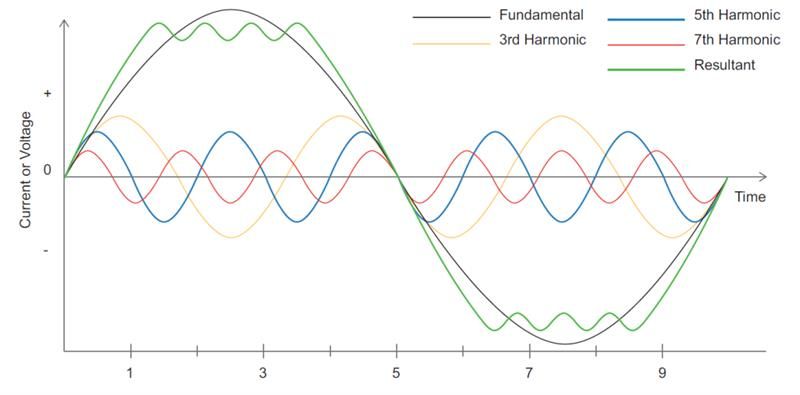
- Black – Fundamental (60 Hz)
The ideal sine wave your system is designed to operate on - Yellow – 3rd harmonic (180 Hz)
Introduces low-frequency ripple into the waveform - Blue – 5th harmonic (300 Hz)
Adds further distortion and pulls current out of phase with voltage - Red – 7th harmonic (420 Hz)
Sharpens peaks and deepens troughs in the waveform - Green – Resultant waveform
The actual voltage or current seen by your equipment, representing the sum of all harmonic components
Each irregularity in the waveform represents wasted energy, excess heat, and additional stress on electrical infrastructure. When multiplied across thousands of servers or large industrial loads, these hidden losses become significant.
Managing Harmonics in Modern Facilities
That is why XCT Energy deploys Active Harmonic Filters that dynamically cancel harmonic distortion in real time. By restoring clean, stable power, these systems:
- Improve efficiency
- Reduce thermal stress
- Protect uptime
- Extend equipment life
Because clean power is not just efficient. It is essential.