Power Harmonics - The Enemy of Energy Efficiency
What Are Power Harmonics?
Power harmonics refer to unwanted electrical frequencies or currents that distort the shape of voltage and current waveforms in an electrical system. These harmonics are typically integer multiples of the fundamental frequency of the power supply.
Most power systems operate at a fundamental frequency of:
- 60 Hz in North America
- 50 Hz in many other regions
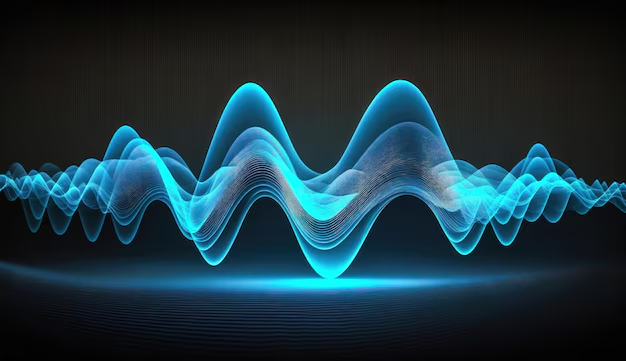
When harmonics are present, the electrical waveform deviates from its intended smooth sine wave, reducing power quality and system efficiency.
Common Sources of Power Harmonics
Power harmonics are most commonly introduced by nonlinear loads, including:
- Electronic devices
Many modern electronic devices such as computers, variable frequency drives (VFDs), LED lighting, and uninterruptible power supplies (UPS) are nonlinear in nature. These devices draw current in short pulses rather than smoothly, which introduces harmonic distortion into the electrical system. - Rectifiers and converters
Equipment that converts alternating current (AC) to direct current (DC), such as rectifiers and converters, often draws current in a non-sinusoidal manner, generating harmonics as a byproduct of normal operation. - Switching power supplies
Commonly found in electronic equipment, switching power supplies rapidly turn transistors on and off to convert AC to DC. This high-speed switching action introduces high-frequency harmonics into the system.
Negative Effects of Power Harmonics
The presence of power harmonics can create several adverse effects on electrical systems and connected equipment.
- Voltage distortion
Harmonics distort the voltage waveform, degrading power quality and potentially causing voltage sags, swells, and flicker that can damage sensitive electronic equipment. - Increased current flow
Harmonics increase the total current flowing through conductors and transformers, leading to overheating, reduced efficiency, and a higher risk of equipment failure. - Transformer overheating
Transformers are particularly sensitive to harmonic currents. Excessive harmonics increase internal losses, leading to overheating and premature insulation degradation. - Resonance
In certain system configurations, harmonics can create resonant conditions that amplify harmonic currents and voltages, further stressing electrical infrastructure.
Standards and Traditional Mitigation Approaches
Power quality standards and regulations exist in many regions to limit allowable harmonic levels and ensure safe, reliable system operation.
Historically, mechanical mitigation techniques such as:
- Harmonic filters
- Line reactors
have been deployed to reduce harmonic effects. While effective in limited scenarios, these solutions are often expensive, bulky, and have relatively short lifespans.
A Modern Approach to Harmonic Mitigation
XCT Energy’s radio frequency-based Power Tuning delivers a hardware and software-driven approach to achieving “perfect power” by actively addressing negative power harmonics and restoring power quality inside the facility.